
Praising Persistence: Helping Canadian Kids Grow with Confidence

Have you ever noticed how often kids rush through homework just to “get it done”? Sometimes the answers are right, sometimes not — but either way, the goal is speed, not understanding.

At MathConcept, we know that confidence in learning doesn’t come from being the fastest in the room. It comes from persistence — the courage to slow down, think carefully, and keep trying, even when it’s tough.

Why Speed Isn’t Everything

In many classrooms or even at home, kids feel pressure to be the first to finish. But finishing quickly doesn’t always mean learning deeply.

Think about it: how many times have you seen your child rush through homework just to say it’s “done”? Pages get filled, answers appear on the paper — but when you look closer, small mistakes slip in, or steps are skipped.

Now compare that to the times your child slowed down, explained their thinking, and double-checked their work. The answers may have taken longer, but the understanding was stronger — and that confidence lasts far beyond one worksheet.

When kids believe that being “fast” is the ultimate goal, they can feel discouraged if they’re not the quickest in the room. Some even start to think, “I’m just not good at this because I’m slower.” That’s a heavy burden for a child to carry.

And it’s true no matter where your family is — whether it’s a Grade 4 student in Vancouver working on long division or a Grade 7 in Toronto tackling algebra. When effort is praised, every child — quick or careful — has the chance to succeed.

When we shift the focus from finishing first to thinking deeply, children start to realise that learning isn’t a race — it’s a journey of understanding.
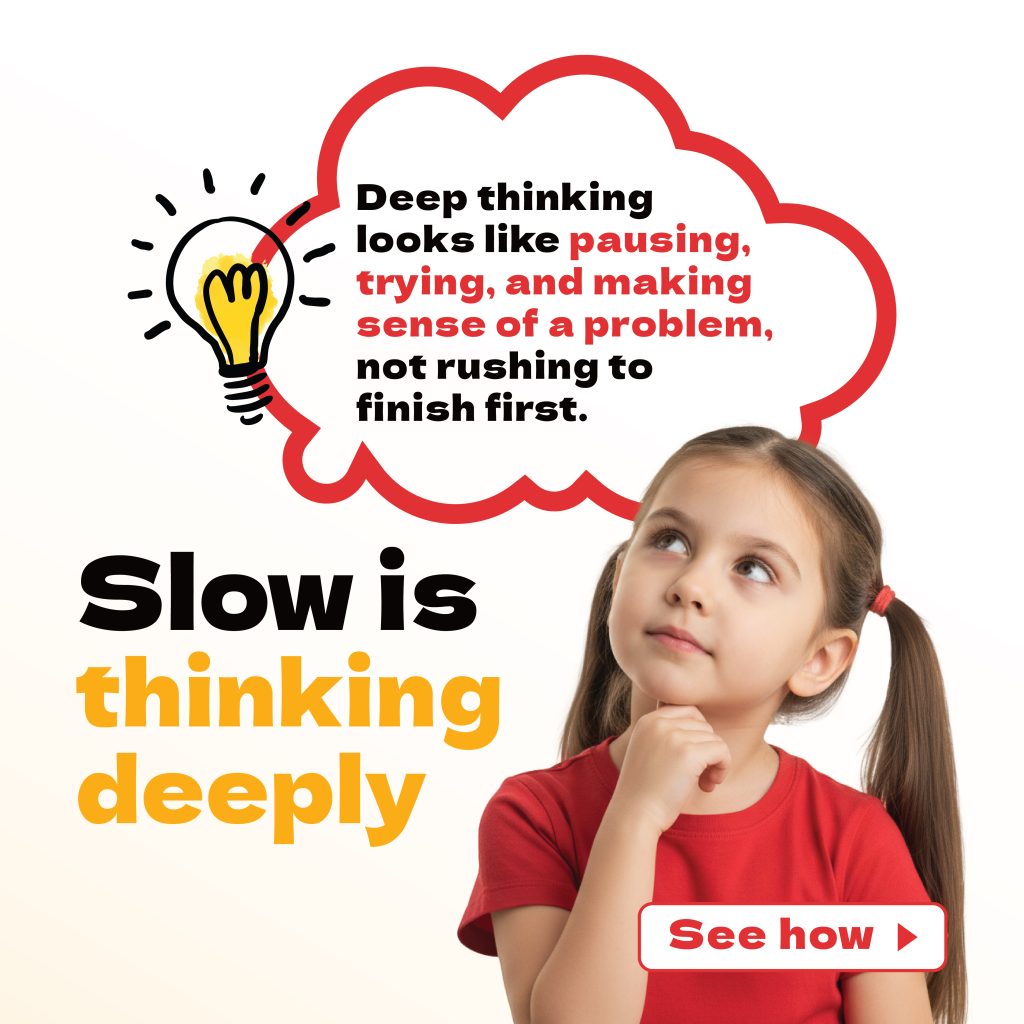
A young girl thinking deeply with a speech bubble explaining that pausing and making sense of a problem builds real understanding — a visual for our “slow is thinking deeply” math learning concept.
When did 'Fast' start meaning 'Smart'? Deep-thinking actually takes time.


The Power of Praising Effort

The words we use matter. They shape how children see themselves and what they believe is important.

Think about the difference between these two moments:

“Wow, you finished so fast!” — It sounds encouraging, but it teaches a child that speed is the main thing to be proud of.

“I like how you kept working through that tricky part.” — Now the focus is on persistence, patience, and problem-solving.

When children hear praise like this, something shifts. They start to believe that effort, not quick answers, is what really matters. Over time, they value the process of learning just as much as the result.

Research shows that specific praise focused on effort and strategy helps children build what psychologists call a growth mindset — the belief that abilities grow with practice and persistence.

Understood.org offers simple growth mindset activities for families here.


What Persistence Builds in Children

When parents and tutors praise persistence, something powerful happens — children stop worrying about being the fastest and start believing in their ability to keep going, no matter how challenging the problem.

Over time, that shift plants seeds that grow into lifelong strengths:
Resilience — learning to bounce back from challenges.
Confidence — knowing they can solve problems step by step.
Calm focus — less pressure to rush, more energy for accuracy.
Lifelong skills — persistence applies far beyond the classroom.

That’s why at MathConcept Canada, we encourage persistence in every classroom — because confidence grows one thoughtful step at a time.

Curious how we help children build this kind of persistence?
Discover how our assessment helps uncover learning strengths.


How We Encourage Persistence at MathConcept

In our classrooms, tutors often remind students: “It’s okay if it takes time — keep going.”

We celebrate when a child tries a second method, checks their work carefully, or explains their reasoning. These small habits matter far more than finishing quickly — they build confidence and independence.

Parents often tell us they notice the difference at home too: their children start approaching challenges with calm, focus, and patience instead of panic.


Tips for Parents at Home

Want to try this at home? Here are a few quick ways to shift the focus from speed to persistence:

✅ Praise effort and strategies, not just quick answers.
✅ Encourage your child to explain how they solved a problem.
✅ Normalise taking time — remind them accuracy matters more than finishing first.
✅ Share your own experiences where persistence paid off.


A Final Word for Parents

Your child doesn’t need to be the fastest to succeed. What truly matters is persistence — the quiet strength to keep trying until understanding clicks.

At MathConcept, we believe effort > speed — every time. By praising persistence, you’re helping your child build the confidence to face challenges in learning and in life.

💛 Want to see this approach in action? Book a free math assessment with us today, and discover how we help Canadian kids grow through persistence, one step at a time.

 
Read more:

Celebrate Mistakes: How Parents Can Turn Math Slip-Ups into Success [Read now]

Discover Your Child’s Strengths and Confidence with a Singapore Math Assessment [Read now]

Pomodoro Technique for Kids: Make Math Time Calmer and Focused [Read now]

MC Math Olympiad

Unleash your child’s full mathematical potential! Our MathConcept Math Olympiad program makes advanced math accessible to all students, not just prodigies. We focus on developing diverse thinking, logical reasoning, and complex problem-solving skills. Students learn to analyze challenges and confidently present solutions, cultivating a positive attitude toward math and improving academic performance.

Note: Currently offered in Chinese. English version in development for global markets.

MC Kindergarten Math Olympiad

Spark your child’s early math genius! Designed for nursery and kindergarten students aged 4-5 with a keen interest in numbers, our Kindergarten Math Olympiad program makes advanced math concepts fun and accessible. Through playful games and real-life activities, we build basic arithmetic, shape recognition, and logical thinking, fostering critical thinking and a genuine love for math from an early age.

Note: Currently offered in Chinese. English version in development for global markets.

High School Final and Public Exams

The senior secondary years (Grade 10-12) are a crucial period for students, where performance directly impacts their academic future and post-secondary aspirations. Recognizing that students arrive with varying skill levels and specific course requirements, our program begins with a comprehensive written diagnostic assessment. Based on these results, we develop a truly customized learning plan designed to efficiently target areas needing improvement, master complex concepts, and avoid unnecessary repetition.

We specialize in providing rigorous preparation for provincial final exams (e.g., Grade 12 provincial diploma exams across Canada) and crucial university-level prerequisites such as Calculus, Advanced Functions, and Pre-Calculus. Our expert tutors possess the advanced qualifications to guide students through the most challenging aspects of these curricula. Additionally, for Canadian students pursuing international pathways, we also offer tailored preparation for major global exams like SAT, IGCSE, IBDP, and HKDSE. Our focus is on equipping every student with the confidence and deep understanding required to excel on their final assessments and confidently embark on their chosen post-secondary journey.

Target: Suitable for High School Students (typically Grade 10 to 12).

Assessment: Students will take a Diagnostic Test before enrollment.

Class Time: Once or twice a week, 1.5 hours class each time, depending on student’s need.

Junior High School

The crucial Grade 7 to Grade 9 years in secondary school are pivotal for building advanced math skills and shaping a student’s confidence for high school. Our comprehensive program not only strengthens foundational knowledge but also expertly introduces core topics like algebra, geometry, trigonometry, and probability – concepts essential for success in subjects across science, technology, and economics.

We meticulously tailor learning plans to each student’s needs, understanding the unique demands of Canadian provincial math curricula . Using a powerful combination of mental, verbal, visual, tactile, and written methods, we ensure students don’t just memorize formulas, but truly understand the ‘why’ behind these more abstract concepts. Our curriculum not only meets but often surpasses these provincial expectations, alongside international benchmarks like IBMYP and British Year 7-9. This holistic approach ensures students are exceptionally well-prepared for their chosen high school math streams and future post-secondary (university/college) requirements across Canada, equipping them with the confidence and critical thinking skills to excel.

Target: Suitable for Junior High School Students (typically Grade 7 to 9).

Assessment: Students will take a Diagnostic Test before enrollment.

Class Time: Once or twice a week, 1.5 hours class each time, depending on student’s need.

Primary School

In primary school, mathematics truly forms the bedrock for all future academic and life success. Our comprehensive program ensures students not only master essential skills like computation, advanced problem-solving, fractions, decimals, and percentages, but also confidently explore enrichment topics such as geometry, measurement, and data analysis.

Our unique approach is significantly influenced by the globally acclaimed Singapore Math curriculum, renowned for its emphasis on conceptual understanding and logical reasoning. We go beyond mere memorization, actively cultivating strong number sense – helping students understand how math works and why it makes sense. Through personalized learning plans and expert instruction that adapts to each student’s needs, we build profound confidence and self-esteem, thoroughly preparing them for the increasing challenges of secondary school and a lifelong appreciation for mathematics.

Target: Suitable for Grade 1 to Grade 6 Students.

Assessment: Students will take a Diagnostic Test before enrollment.

Class Time: Once or twice a week, 1.5 hours class each time, depending on student’s need.

Kindergarten

MathConcept Little First Steps (Age 3)

Our Little First Steps program nurtures early childhood learners’ natural curiosity about math. Through playful and interactive activities, we help children organize and make sense of their world by exploring counting, recognizing shapes, and identifying patterns, laying the groundwork for kindergarten math readiness.

MathConcept First Steps (Kindergarten Age 4 to 5)

Tailored for kindergarten learners, First Steps focuses on building foundational math skills while addressing individual strengths and weaknesses. Using a blend of mental, verbal, visual, tactile, and written methods, this multi-sensory approach ensures basic math concepts and logical thinking truly ‘click’ for every learning style, deeply preparing children for primary school.

Target: Suitable for Kindergarten and Grade 1 Students.

Assessment: Students will take a Diagnostic Test before enrollment.

Class Time: Once or twice a week, 45 minutes class each time, depending on student’s need.